
What is Enterprise 2.0 all about? IMHO – this is the most asked question when talking about this topic. As several bright heads have said before instead of theoretically talking about the Enterprise 2.0 vision we need to talk about use cases and case studies that show and unveil the power of this so-called “social business“. At the Enterprise 2.0 SUMMIT we have defined four different use cases that are going to be discussed along different best practices presentation. And while setting up an explanation of these use cases two days ago I ran along this nice post of discussing the “nexus of business process & ad-hoc collaboration” that led me to an idea of a more broader view on the topic to be discussed in the following.
In his post Larry Hawes refers to post of Sameer Patel discussing the difference between ECM systems and social software:
ECM enables controlled, repeatable content publication processes, whereas social software empowers rapid, collaborative creation and sharing of content. There is a place for both in large enterprises. Sameer’s suggestion was that social software be used for authoring, sharing, and collecting feedback on draft documents or content chunks before they are formally published and widely distributed. ECM systems may then be used to publish the final, vetted content and manage it throughout the content lifecycle.
This relates to my understanding why enterprises need such thing as social software – because they need to change and to innovate in order to be more competitive in their markets. Consequently they have to discover new opportunities, ideas and information that is describing or representing these. And as a result from the organizational perspective companies need some kind of “reframing” of their business model.
Inspired by the post of Larry Hawes I would therefore describe the difference between established enterprise business applications and Enterprise 2.0 on a dimension of how the application is supporting the “reframing” process (I am explicitly not talking about “change” or “transformation” here because IMHO “change” is a consciousness thing needed to be done before and “transformation” might go far beyond the needed “reframing” in order to be up-to-date to customer and market expectations).
On this dimension established enterprise business application are “securing the precedent”. They support the planning-and-control-organization of the current operations by registering and certifiably documentating business incidents. The applications provide insights towards the historical status-quo of the business operations and can be distinguished by the business entity it is focussing on. On the one side there are established and defined processes and on the other side business-relevant data and unstructured information that have to be managed throughout their lifecycle.
If we take the scenario of Larry Hawes regarding the customer service issue there are business incidents – commonly in the sphere of knowledge working – that exceed these pre-defined processes and information structures. For these incidents the staff needs to move beyond the status-quo of defined processes and stored information. Former approaches to this used special methodologies like delphi studies and artificial intelligence toforcast the future in order to discovery new opportunities. At this point – social software offers a new approach – as it provides a way of harnessing the collective power of a interconnected setting of people to discover and ventilate new ideas – by externalizing and opening up data about information chunks, knowledge and process execution towards the crowd.
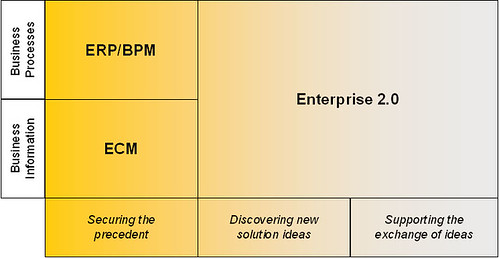
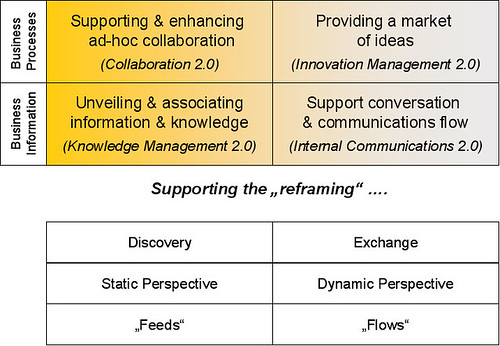
In regards towards this dimension of “reframe” I hence distinguish two further steps: first the “discovery” and second the “exchange”. This takes account of the idea of the learning organization that focuses on enhancing its systems to continually increase the organization’s capacity for performance. It also supports a phrase I first came along in a presentation of : “It’s all about managing feeds & flows, and not objects“.
Along with the differenciation of business processes and business information, it helps again to keep apart four different use case scenarios of Enterprise 2.0:
-
Unveiling & associating information & knowledge (Knowledge Management 2.0):
This is about working collaboratively on a state of externalized business knowledge e.g. project/process documentation, service issue/process documentation or sales-orientated product & market documentation. Giving access and authoring as well as sharing possibilities to the crowd creates the chance of someone adding not expected, but very valuable information towards the knowledge base and therefore enhancing it. -
Support conversation & communications flow (Internal Communications 2.0):
This is about the exchange and open discussion of new opportunities, ideas or gained knowledge throughout conversational systems as weblogs or microblogging infrastructures. This supports the distribution and ventilation of new ideas throughout the company – eventually reaching out to people that can give valuable feedback to ideas. -
Supporting & enhancing ad-hoc collaboration (Collaboration 2.0):
This is about supporting ad-hoc initiated team working to solve issues and problems that go beyond the pre-defined scope of problems or issues. As this would have been solved in offline circles of expertise so far Enterprise 2.0 approaches allow this to be solved on in a digital Enterprise-wide manner. -
Supporting the learning organization and providing a market of ideas (Innovation Management 2.0):
This is about interconnecting business entities with people and information about their tasks, interests and competences. Community-of-practices are a common tool for this approach though in times of social software this would rather implemented by an internal social network that is giving even a broader access to people and the relevant information flows within the enterprise.
Just to be clear the above mentioned use cases are not directly linked to technological solutions but certain social software concepts fit better to the one or the other use case. Therefore wiki solutions provide a good approach towards the collaborative knowledge work. While weblogs and microblogging solutions are better in giving access to the flow of information. And social networks provide advantages for supporting collaboration and the learning organization.
At the Enterprise 2.0 SUMMIT we will discuss different best practices for these four use cases and I will sum up my insights regarding the fit of this matrix towards the practical use out there in a post after the conference. But before this I would be very interested in your thoughts on this!


RT @enterprise20: New blog post: Classification of Enterprise 2.0 use cases http://bit.ly/3iq4oi
This comment was originally posted on
RT [at] enterprise20: New blog post: Classification of Enterprise 2.0 use cases http://bit.ly/3iq4oi:
Mar.. http://bit.ly/4Dvl9n
This comment was originally posted on
Sehr gut zusammengefasst: RT @enterprise20: New blog post: Classification of Enterprise 2.0 use cases http://bit.ly/3iq4oi
This comment was originally posted on
habe dann heute morgen mal über E20 gebloggt (http://bit.ly/3iq4oi) – würde dazu gerne beim #bcmuc auch ne Session machen. Interesse?
This comment was originally posted on
RT @frogpond RT @enterprise20: New blog post: Classification of Enterprise 2.0 use cases http://bit.ly/3iq4oi
This comment was originally posted on
Gedankenfutter: RT @enterprise20: New blog post: Classification of Enterprise 2.0 use cases http://bit.ly/3iq4oi
This comment was originally posted on
RT @dhinchcliffe: Continuing a great riff, @bn_at_twitter explores Classification of Enterprise 2.0 Use Cases today: http://bit.ly/232gCN
This comment was originally posted on
RT @arimue RT @enterprise20 New blog post: Classification of Enterprise 2.0 use cases http://bit.ly/3iq4oi
This comment was originally posted on
Classification of Enterprise 2.0 use cases What
is Enterprise 2.0 all about? http://bit.ly/DpH0z
This comment was originally posted on
Classification of Enterprise 2.0 use cases http://bit.ly/yWpmT
This comment was originally posted on
RT @Agotthelf: RT @t_de_baillon RT @frogpond: RT @enterprise20: New blog post: Classification of Enterprise 2.0 cases http://bit.ly/3iq4oi
This comment was originally posted on
Enterprise 2.0 Business Strategy: Exploring Use Cases -> http://bit.ly/2mjBs #KM, Workflows, Collaboration in #E20 via @HannsKK
This comment was originally posted on
RT @webtechman@HannsKK: Enterprise 2.0 Business Strategy: Exploring Use Cases -> http://bit.ly/2mjBs #KM, Workflows, Collaboration in #E20
This comment was originally posted on
RT @lammiia: Classification of Enterprise 2.0 use cases http://bit.ly/3iq4oi #e20
This comment was originally posted on
RT @enterprise20: New blog post: Classification of Enterprise 2.0 use cases http://bit.ly/3iq4oi
This comment was originally posted on
RT @JoachimNiemeier: RT @enterprise20: New blog post: Classification of Enterprise 2.0 use cases http://bit.ly/3iq4oi
This comment was originally posted on
Enterprise 2.0 Use Case Classifications http://ow.ly/uGLd
This comment was originally posted on
Enterprise 2.0 Use Case Classifications http://ow.ly/uGLs
This comment was originally posted on
Bjorn
Thanks for asking me to comment. I really like the classification into the four use cases. I’ll share with you that I usually talk about five organizational sources of the conversation (as opposed to four cases), but I think they are almost exact matches. These are (in no specific order):
1. The Knowledge Management Department (if a company has one of these). These are more frequently found in firms and agencies. They start the conversation from the perspective of document or records mgt and are looking to solve problems related to learning and on-boarding of new employees.
2. Idea Harvesting. Most typically in companies with an innovation management or new product department. These innovation or idea-focused initiatives look to leverage voice of customer (not really e2.0 per se) or voice of employee to help with new product development or other business initiatives.
3. Marketing departments and their Social media campaigns. Many times someone in the marketing department has some responsibility to ensure that there can be an effective internal reaction to an external project. This opens the question – which should we do first? Some groups have their internal comm group report into marketing — so they initiate the conversation as a “intranet home page refresh project”. Sometimes they look at E2.0 as an R&D project.
4. Virtual Teams collaboration. In some organizations this comes from HR or even a Project Management Office. The conversation is related to a global outsourcing project or some other workforce changes (layoffs, mergers) — it is related in spirit to the KM initiative, but given the source, the nature of the conversation is very different in practice.
5. Intranet / Portal 2.0. Many times the conversation starts from the IT department. They may be looking at a technology refresh or a desire to provide new services to the workforces (or more specifically a new portal/platform that happens to have social technologies.
These are the 5 places within organizations that I find most frequently initiate the e2.0 conversation. The KM and Innovation cases match directly to mine. The other two use cases relate to my three sources (though I admit that my classification of 5 is not very strict either).
So I like your uses cases since they are crisp.
Bjorn
Thanks for asking me to comment. I really like the classification into the four use cases. I’ll share with you that I usually talk about five organizational sources of the conversation (as opposed to four cases), but I think they are almost exact matches. These are (in no specific order):
1. The Knowledge Management Department (if a company has one of these). These are more frequently found in firms and agencies. They start the conversation from the perspective of document or records mgt and are looking to solve problems related to learning and on-boarding of new employees.
2. Idea Harvesting. Most typically in companies with an innovation management or new product department. These innovation or idea-focused initiatives look to leverage voice of customer (not really e2.0 per se) or voice of employee to help with new product development or other business initiatives.
3. Marketing departments and their Social media campaigns. Many times someone in the marketing department has some responsibility to ensure that there can be an effective internal reaction to an external project. This opens the question – which should we do first? Some groups have their internal comm group report into marketing — so they initiate the conversation as a “intranet home page refresh project”. Sometimes they look at E2.0 as an R&D project.
4. Virtual Teams collaboration. In some organizations this comes from HR or even a Project Management Office. The conversation is related to a global outsourcing project or some other workforce changes (layoffs, mergers) — it is related in spirit to the KM initiative, but given the source, the nature of the conversation is very different in practice.
5. Intranet / Portal 2.0. Many times the conversation starts from the IT department. They may be looking at a technology refresh or a desire to provide new services to the workforces (or more specifically a new portal/platform that happens to have social technologies.
These are the 5 places within organizations that I find most frequently initiate the e2.0 conversation. The KM and Innovation cases match directly to mine. The other two use cases relate to my three sources (though I admit that my classification of 5 is not very strict either).
So I like your uses cases since they are crisp.
RT @lammiia, @enterprise20: Classification of Enterprise 2.0 use cases http://bit.ly/3iq4oi #e20
This comment was originally posted on
Enterprise 2.0 in categories http://tinyurl.com/yg8s3oo #fb
This comment was originally posted on
RT @benboeser: Enterprise 2.0 in categories http://tinyurl.com/yg8s3oo
This comment was originally posted on
Classification of Enterprise 2.0 use cases http://ff.im/-9WJgb
This comment was originally posted on
Hi Björn,
I like the piece in general, and I broadly agree with the four use cases, bit I think there are various affordances and effects of social computing that do not neatly fit into these categories, especially when defined as [old term] 2.0.
I look forward to discussing it fully in Frankfurt!
Hi Björn,
I like the piece in general, and I broadly agree with the four use cases, bit I think there are various affordances and effects of social computing that do not neatly fit into these categories, especially when defined as [old term] 2.0.
I look forward to discussing it fully in Frankfurt!
RT @edwinvdg:Classification of Enterprise 2.0 use cases http://ff.im/-9WJgb
This comment was originally posted on
RT @dhinchcliffe: Continuing a gr8 riff, @bn_at_twitter explores the Classification of Enterprise 2.0 Use Cases 2day: http://bit.ly/232gCN
This comment was originally posted on
Reframing the E2.0 Use Case – valuable distinctions – “Classification of Enterprise 2.0 use cases http://bit.ly/zUYbg #ngenera
This comment was originally posted on
I still have a bit of a problem with limiting the definition of Enterprise 2.0 to social networks and collaborative tools. What about other technologies that extend the power of existing organizations’ applications?
I still have a bit of a problem with limiting the definition of Enterprise 2.0 to social networks and collaborative tools. What about other technologies that extend the power of existing organizations’ applications?
Reading: Classification of Enterprise 2.0 use cases http://bit.ly/yWpmT
This comment was originally posted on
RT @bduperrin Classification of Enterprise 2.0 use cases – http://bit.ly/yWpmT
This comment was originally posted on
Bjorn,
I really like this classification!
Would you mind if I used it in a conference I’m speaking at next week? With the credits of course!
Bjorn,
I really like this classification!
Would you mind if I used it in a conference I’m speaking at next week? With the credits of course!
Great way to classify! RT @bduperrin: Reading: Classification of Enterprise 2.0 use cases http://bit.ly/yWpmT
This comment was originally posted on
Reading: Classification of Enterprise 2.0 use cases http://bit.ly/yWpmT http://ff.im/a0VcZ
This comment was originally posted on
RT @fredzimny: Reading: Classification of Enterprise 2.0 use cases http://bit.ly/yWpmT http://ff.im/a0VcZ > grt stuff
This comment was originally posted on
@Xavier – you are welcome to use it – the images are linked to Flickr images with even bigger ones. Regards.
@Xavier – you are welcome to use it – the images are linked to Flickr images with even bigger ones. Regards.
Classification of Enterprise 2.0 Use Cases: http://is.gd/4o2pZ {I like the descriptions of the use cases. Gets the wheels turning.}
This comment was originally posted on
RT @rharbridge: Classification of Ent 2.0 Use Cases: http://is.gd/4o2pZ {I like the descriptions of the use cases. Gets the wheels turning.}
This comment was originally posted on
RT @dhinchcliffe Continuing a great riff, @bn_at_twitterexplores the Classification of Enterprise 2.0 Use Cases today: http://bit.ly/232gCN
This comment was originally posted on
Classification of Enterprise 2.0 use cases http://bit.ly/yWpmT
This comment was originally posted on
social software offers a new approach. Enterprise 2.0 use cases #SKM2.0 http://bit.ly/yWpmT
This comment was originally posted on
@bn_at_twitter Proposed “Classification of Enterprise 2.0 use cases” builds on thinking of @lehawes & @sameerpatel http://bit.ly/1sXfT0
This comment was originally posted on
Bjorn,
I’m pleased and sincerely flattered that you were inspired by my blog post (as I was by Sameer Patel’s). There is much more thinking and communication to be done on the relationship of structured business processes and ad hoc communication/collaboration. Your inclination to define and apply high-level use cases as a guiding framework is spot-on and commendable. We need to discuss the issue in language that business people will understand and value.
The reframing and use case frameworks you’ve proposed here are a really good start. However, the quadrant diagram with the four use cases seems to be missing a dimension. You have labeled the Y-axis categories (Business Process and Business Information), but have no label for the two categories on the X-axis. What business concepts could you apply to create a well-formed BCG matrix?
I’ve been doing quite a bit of (unpublished) thinking on this subject lately that I would like to share with you, because it varies in one meaningful way from your frameworks. Namely, I don’t agree with your distinction between “securing the precedent” and new ways of “discovering and exchanging ideas”. In my draft framework (and ideal situation), Command and Control (structure) and Social Business (dynamic network) exist on the same plane — they are not separated as in your “reframing” diagram.
A significant consequence of the difference between your and my approach is that I include a third dimension in addition to your “Business Processes” and “Business Information” categories. I see business users being served by composite applications mashed up from three service streams: Process Services, Content Services, and People Services.
In my model, Traditional and Enterprise 2.0 functionality can exist in the same application and may be applied in the same use case. The goal is to design role-specific applications that support users efficiently and seamlessly, rather than forcing them to switch between multiple, disparate applications to accomplish work.
I hope to publish these ideas soon, in the form of more complete thoughts and diagrams. In the meantime, I’d welcome your input on my approach and encourage you to keep working on your frameworks as well. By exploring the relationship of structured and ad hoc work from different angles, and discussing those differences as we are here, we should eventually design a framework that makes sense to both us and our clients.
Bjorn,
I’m pleased and sincerely flattered that you were inspired by my blog post (as I was by Sameer Patel’s). There is much more thinking and communication to be done on the relationship of structured business processes and ad hoc communication/collaboration. Your inclination to define and apply high-level use cases as a guiding framework is spot-on and commendable. We need to discuss the issue in language that business people will understand and value.
The reframing and use case frameworks you’ve proposed here are a really good start. However, the quadrant diagram with the four use cases seems to be missing a dimension. You have labeled the Y-axis categories (Business Process and Business Information), but have no label for the two categories on the X-axis. What business concepts could you apply to create a well-formed BCG matrix?
I’ve been doing quite a bit of (unpublished) thinking on this subject lately that I would like to share with you, because it varies in one meaningful way from your frameworks. Namely, I don’t agree with your distinction between “securing the precedent” and new ways of “discovering and exchanging ideas”. In my draft framework (and ideal situation), Command and Control (structure) and Social Business (dynamic network) exist on the same plane — they are not separated as in your “reframing” diagram.
A significant consequence of the difference between your and my approach is that I include a third dimension in addition to your “Business Processes” and “Business Information” categories. I see business users being served by composite applications mashed up from three service streams: Process Services, Content Services, and People Services.
In my model, Traditional and Enterprise 2.0 functionality can exist in the same application and may be applied in the same use case. The goal is to design role-specific applications that support users efficiently and seamlessly, rather than forcing them to switch between multiple, disparate applications to accomplish work.
I hope to publish these ideas soon, in the form of more complete thoughts and diagrams. In the meantime, I’d welcome your input on my approach and encourage you to keep working on your frameworks as well. By exploring the relationship of structured and ad hoc work from different angles, and discussing those differences as we are here, we should eventually design a framework that makes sense to both us and our clients.
Finally commented on the blog post by @bn_at_twitter, http://is.gd/4q0L1, which was inspired by one of my posts, http://is.gd/4q0S8.
This comment was originally posted on
reading the great comment of @lehawes on the article about E2.0 use case classification http://bit.ly/3pdLnC
This comment was originally posted on
RT @enterprise20: reading the great comment of @lehawes on the article about E2.0 use case classification http://bit.ly/3pdLnC
This comment was originally posted on
Enterprise 2.0 use cases http://bit.ly/yWpmT (via @PASSELAIGUE)
This comment was originally posted on
@Larry –
looking forward to your published thoughts. I know that my thinking for this framing is limited as it focusses on one upfront intention for the E2.0 activity: improve the way you (re-)innovate in order to gain competiveness in the market. I think this is a major objective of a lot projects but certainly there may be others.
Regards. Bjoern
@Larry –
looking forward to your published thoughts. I know that my thinking for this framing is limited as it focusses on one upfront intention for the E2.0 activity: improve the way you (re-)innovate in order to gain competiveness in the market. I think this is a major objective of a lot projects but certainly there may be others.
Regards. Bjoern
Classification of Enterprise 2.0 use cases http://bit.ly/2MXDOR
This comment was originally posted on
RT @Concepthubinc:Classification of Enterprise 2.0 use cases http://bit.ly/2MXDOR
This comment was originally posted on
Reading Classification of Enterprise 2.0 use cases http://bit.ly/yWpmT
This comment was originally posted on
Clay Shirky is still relevent. I appreciate the model of servant Leadership as well. Is E2 a revolution? Well I can tell you from the trenches of an enterprise collaboration tool called Cogenuity that the answer is YES!
This comment was originally posted on Enterprise2Open
The post is written in very a good manner and it entails many useful information for me. I am happy to find your distinguished way of writing the post. Now you make it easy for me to understand and implement the concept.
One question that we deal with most often is “What are the primary use cases for social business software in an enterprise.” And it is indeed the most intelligent question to ask. Here is the short and sweet answer. Any thing more than this, in our opinion, in unnecessary marketing talk
- Collaboration and Knowledge exchange among employees and partners
- Enterprise communication: Chatting, micro blogging, discussions, forums
- Social networking and Expert search and reach out
- User profiles and personal information management
- Project and tasks management
http://www.inkattech.com/what-are-the-key-use-cases-for-social-business-software/